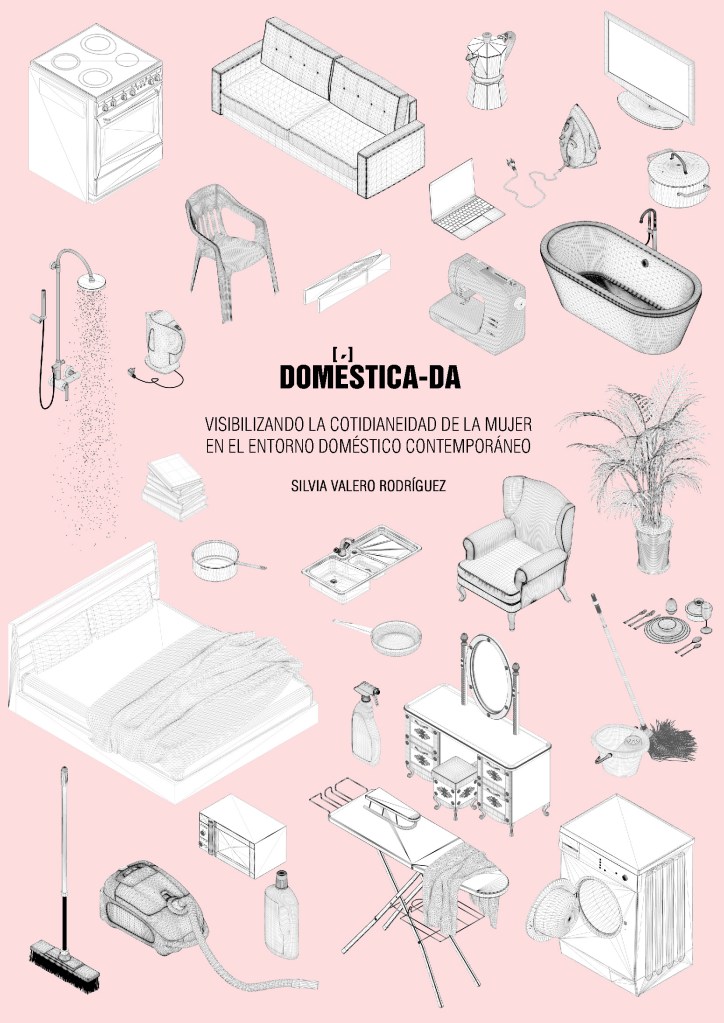
Valero Rodríguez, S. (2016). DOM(É)STICA-DA : visibilizando la cotidianeidad de la mujer en el entorno doméstico contemporáneo. http://hdl.handle.net/10251/79167.
Supervisors: Eva Alvarez, Carolina Mateo and Begoña Serrano
https://riunet.upv.es/handle/10251/79167
For the creation of domestic architecture, some postulates are taken from the social daily nature. Those are related to certain activities seen as unique and fundamental in our daily development, such as sleeping, eating or washing. These principles are translated into generally segregated and single-function spaces, which are not only a connection with a series of biological activities, but also containers of symbolic values, favouring a specific configuration of our collective imagination and determining certain social roles which promote, among others, the gender division. Historically, this paradigmatic discrimination between men and women has remained in housing design. Thus, the division of gender roles has been reflected in the interior home design and, as a matter of fact, the spatial configuration has contributed to the repetition of this stereotyping over time. In this environment, the main subject of study for this research is the visibility of the role of women and the inclusion of the perspective of women in housing design. Giving voice to those who have traditionally been excluded from the architectural theory and practice, in order to contribute to a reflection on architecture that helps to eradicate the gender roles associated to domestic space. In short, a more inclusive and equitable architecture, committed to its social context.
 caryatides
Leave a comment